
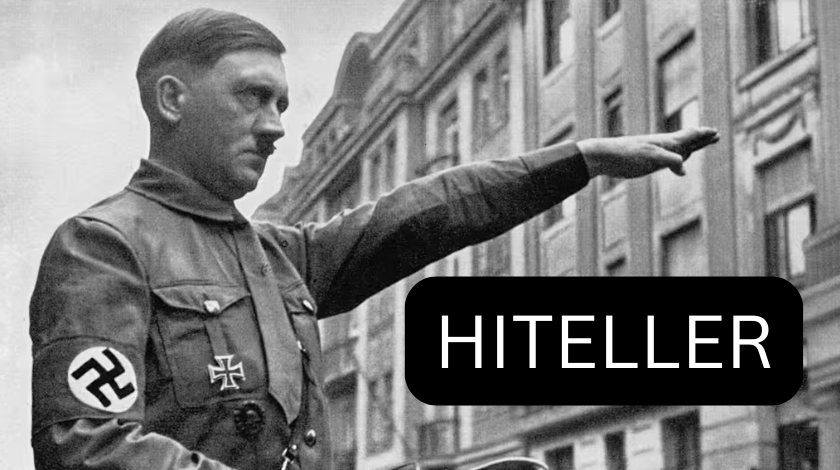
Have you ever typed a name into a search bar and felt a flicker of doubt? Maybe you’ve seen “Hiteller” online, in a comment section, or even in a hastily written essay. I know I have. Early in my own journey of learning about history, I encountered various spellings and felt that confusion. It’s a natural starting point for many. Today, I want to talk about this specific word—”Hiteller”—not to shame anyone for a typo, but to use it as a gateway. It’s a perfect example of how a small error can lead us to a much bigger and more important conversation about one of the most devastating figures in modern history: Adolf Hitler.
Let’s clear this up first, with kindness and clarity. “Hiteller” is a common misspelling of the German dictator’s surname, Hitler. The mix-up is understandable. When we say “Hitler” in English, the “t” sound can sometimes be heard as a soft “d” or can get doubled in our minds, leading to the extra “l”. It’s a phonetic error. Some might also unconsciously link it to words like “teller.” But in the realm of historical study, accuracy in names is not just about being pedantic. It’s about respect for the gravity of the subject and precision in understanding. When we search for “Hiteller,” what we are truly seeking to understand is Adolf Hitler, the man whose actions shaped the 20th century in the most tragic ways.
So, who was Adolf Hitler? To move beyond the misspelling, we need to look at the man and the world he broke. He was born in Austria in 1889, a young man who dreamed of being an artist but faced rejection. This period of his life, often filled with struggle and a growing sense of anger, is key. He served as a soldier in World War I, an experience that left him embittered by Germany’s defeat. He, like many others, looked for someone to blame. This is where his path took a dark turn. He began to channel his personal frustrations and the widespread national humiliation into a toxic ideology. He pointed fingers at politicians, communists, and most viciously, at Jewish people, whom he falsely scapegoated for all of Germany’s problems.
His rise to power wasn’t a sudden coup; it was a slow, chilling process that exploited a broken system. In the 1920s and early 1930s, Germany was reeling. The Weimar Republic was weak, the economy was in ruins after the Great Depression, and people were desperate for a strong leader who promised simple, forceful solutions. Hitler, a surprisingly captivating public speaker for those drawn to his message, was that for many. He didn’t just give political speeches; he staged rallies, used emerging radio technology, and mastered propaganda. I remember watching old newsreel footage in a university class—the sheer scale of the Nuremberg Rallies, the synchronized crowds, the overwhelming visuals. It wasn’t just politics; it was a spectacle designed to overpower critical thought and sell a narrative of national rebirth through unity and purity.
By 1933, through a combination of legal maneuvering, intimidation, and backroom deals, Hitler was appointed Chancellor. What followed was the swift dismantling of German democracy. He used fear, like the infamous Reichstag Fire, to push through laws that gave him ultimate power. Soon, opposition parties were banned, basic freedoms were erased, and the Nazi state was built on a foundation of militarism, nationalism, and racial hatred. This is the critical lesson: Hitler did not operate in a vacuum. He was enabled by economic despair, political instability, and the willingness of many to look the other way or even cheer as the rights of their fellow citizens were stripped away. It’s a stark reminder for all societies about the fragility of democratic institutions.
The consequences of his ideology were the Second World War and the Holocaust. In 1939, his invasion of Poland ignited a global conflict that would claim an estimated 70-85 million lives. But the war was also a cover for the regime’s central, monstrous crime: the systematic murder of six million Jewish men, women, and children, along with millions of others including Roma, disabled individuals, political opponents, and LGBTQ+ people. The Holocaust, or Shoah, stands as a profound warning of where unchecked hatred and dehumanization can lead. Visiting a Holocaust memorial or reading a survivor’s testimony, as I have done, is a deeply humbling and heartbreaking experience. It transforms statistics into human stories, making the historical imperative to remember and learn feel intensely personal.
Hitler’s reign ended in 1945 with his suicide in a Berlin bunker as Allied forces closed in. Germany lay in ruins, Europe was shattered, and the world was forever changed. The post-war era was defined by efforts to build international cooperation, like the United Nations, and to establish universal human rights, directly in response to the horrors of the Nazi regime.
So, why does this history—and getting the name right—matter so much today? When we say or type “Hiteller,” it’s a small signal that our knowledge might be second-hand or fuzzy. Diving deeper to correct that spelling is the first step toward taking the history seriously. We study this period not to dwell on darkness, but to inoculate ourselves against the patterns that led to it. We learn about propaganda to recognize it in our own media landscapes. We learn about scapegoating to call it out when we see it happening to any group. We learn about the collapse of democratic norms to better defend our own.
In my opinion, based on years of reading and teaching this material, the greatest danger is forgetting the human scale of it all. Hitler was not a cartoon villain or a supernatural force of evil. He was a human being who made choices, and millions of other human beings followed, supported, or allowed those choices. That’s uncomfortable, because it means the capacity for great wrong exists within human systems and societies. But the opposite is also true. The capacity for courage, resistance, and moral clarity is also profoundly human. We honor the victims and the heroes of that time not just by remembering the name “Hitler” accurately, but by understanding the mechanics of history and committing to building a world where such ideologies cannot find fertile ground again.
Conclusion
The journey from a simple misspelling like “Hiteller” to the complex history of Adolf Hitler is more than a lesson in accuracy. It is a necessary journey into understanding one of the darkest chapters of our shared past. By clarifying the name, we open the door to examining the man, his ideology, the conditions that allowed his rise, and the catastrophic consequences that followed. This history is not a distant relic; it is a living lesson in the value of democracy, the dignity of every individual, and the eternal vigilance required to protect them. Remembering correctly is the first, vital step in learning wisely.
Frequently Asked Questions (FAQ)
Q1: Is “Hiteller” ever the correct spelling?
A1: No, “Hiteller” is not the correct spelling. It is always a misspelling or typographical error. The correct surname of the Nazi dictator is Hitler.
Q2: Why do people so often misspell it as “Hiteller”?
A2: It’s primarily a phonetic error. When spoken quickly, the “t” in “Hitler” can sound soft, and people may unconsciously add an extra “l.” It also may be influenced by similar-sounding English words.
Q3: What is the most important thing to know about Adolf Hitler?
A3: Beyond the biographical facts, the most crucial understanding is that his ideology of racial hatred and extreme nationalism led to World War II and the Holocaust, demonstrating the catastrophic real-world impact of fascist, authoritarian ideas.
Q4: Why is it important to study such a dark period of history?
A4: We study this history to understand how societies can break down, how propaganda works, and where hatred can lead. It is essential learning to help prevent similar atrocities in the future and to foster respect for human rights and democracy.
Q5: Where can I find accurate and reliable information about this topic?
A5: Reputable sources include documentaries and archives from institutions like the United States Holocaust Memorial Museum (USHMM), Yad Vashem, the BBC History site, and academic history books by respected scholars. Always look for sources that are based on documented evidence.